Corrosion Management and Monitoring Services in the UAE
Managing Corrosion Through Planned Monitoring and Control
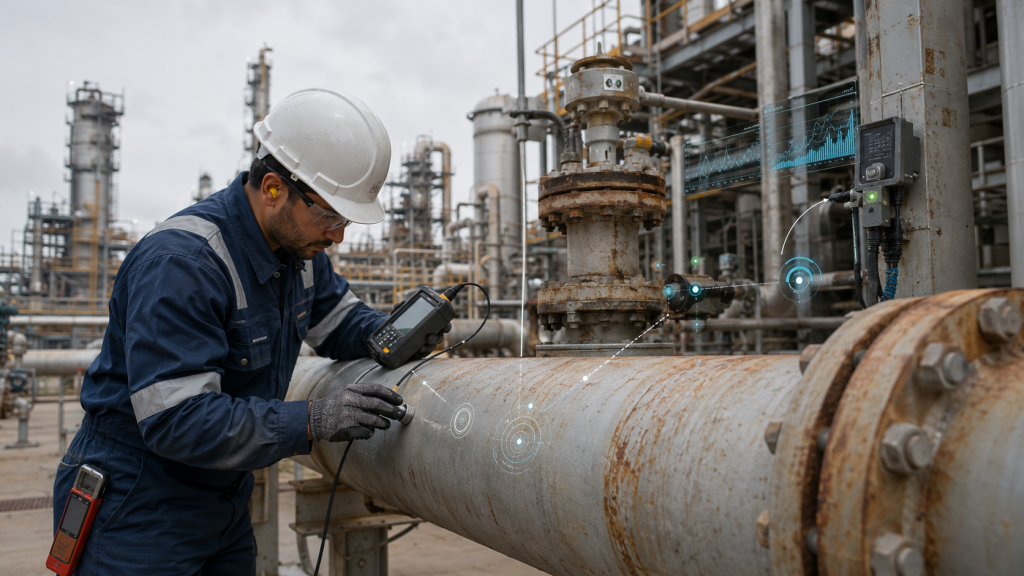
Corrosion management is an ongoing process that converts identified corrosion threats into practical inspection, monitoring, mitigation and performance-review activities. Colossal Consultants helps operators develop structured corrosion management programmes for pipelines, process facilities, storage systems and other critical assets.
Our services integrate corrosion circuits, monitoring locations, inspection findings, process conditions, chemical treatment performance and corrosion-rate trends into a coordinated programme. This enables asset owners to detect deterioration early, evaluate whether controls are effective and continuously improve corrosion-control activities throughout the asset lifecycle.
Our Corrosion Management and Monitoring Approach
A corrosion management programme begins by defining the asset boundaries, operating context, corrosion threats, existing control measures, responsibilities and performance objectives. We review relevant P&IDs, equipment and line lists, materials, operating conditions, inspection history, failure records, chemical-treatment information and available corrosion-monitoring data to establish the current condition and management baseline.
The information is then organised into practical corrosion circuits or management units. For each circuit, the credible degradation mechanisms, required control measures, monitoring locations, techniques, frequencies, alert limits and responsible personnel are defined. The programme may integrate corrosion coupons and probes, ultrasonic thickness measurements, process-chemistry results, chemical-treatment performance, inspection findings and operating-condition trends.
Monitoring results are periodically reviewed to confirm whether corrosion controls remain effective. Adverse trends or limits being exceeded can trigger additional inspection, operating adjustments, chemical-treatment changes or specialist investigation. Unlike a one-time CRAS or a quantitative RBI calculation, corrosion management provides an ongoing framework for controlling deterioration and improving asset-integrity performance throughout the operating lifecycle.
A Practical Corrosion-Control Programme and Clear Deliverables
The completed programme connects identified corrosion threats with control measures, monitoring activities, action limits and accountable personnel. It provides a traceable basis for detecting deterioration, evaluating control effectiveness, escalating abnormal findings and continuously improving corrosion performance.
Typical deliverables may include:
- Corrosion management philosophy and implementation strategy
- Corrosion circuits or corrosion-management-unit register
- Circuit-wise degradation-mechanism and control review
- Corrosion-control matrices and key operating parameters
- Monitoring locations, methods, frequencies and action limits
- Corrosion coupon, probe and thickness-monitoring schedules
- Process-chemistry and chemical-treatment performance review
- Corrosion-rate trending, KPIs and reporting templates
- Integration of inspection, monitoring and operating data
- Roles, responsibilities, escalation workflows and review intervals
- Management-of-change triggers and programme-update requirements
- Corrective-action and continuous-improvement register
- Recommendations for separately scoped CRAS, RBI, Fitness-for-Service, laboratory testing or specialist corrosion assessments
Material & Corrosion
- Failure Analysis and Root Cause Investigation
- Material Selection and Corrosion Engineering
- Corrosion Risk Assessment Study – CRAS
- Corrosion Management and Monitoring
- Corrosion Under Insulation Assessment and Management
- Microbiologically Influenced Corrosion Assessment and Control
- Coating Assessment and Evaluation
- Cathodic Protection
- Corrosivity and Corrosion Testing
Corrosion Management and Monitoring FAQs
A corrosion management and monitoring programme is an ongoing framework for controlling corrosion throughout an asset’s operating life. It defines corrosion threats, control measures, monitoring techniques, frequencies, action limits, responsibilities and review requirements so deterioration can be detected and addressed before integrity is compromised.
A Corrosion Risk Assessment Study identifies and prioritises corrosion threats at a defined point in time. Corrosion management converts those findings and other integrity information into continuing monitoring, mitigation, performance review and corrective-action activities.
Depending on the asset and degradation mechanisms, the programme may include corrosion coupons, electrical-resistance or linear-polarisation probes, ultrasonic thickness monitoring, process-chemistry testing, chemical-treatment monitoring, inspection findings, operating-condition trends and corrosion-rate analysis.
Review frequency depends on asset criticality, corrosion rates, operating changes and monitoring results. Programmes are commonly reviewed periodically and whenever action limits are exceeded, significant process changes occur, unexpected damage is found or new inspection information becomes available.
No. Corrosion management coordinates ongoing corrosion-control and monitoring activities. Risk-Based Inspection determines risk-based inspection priorities, while specialist corrosion testing generates specific laboratory or field data. These services complement one another but have different objectives.