
Corrosion Under Insulation Assessment and Management Services in the UAE
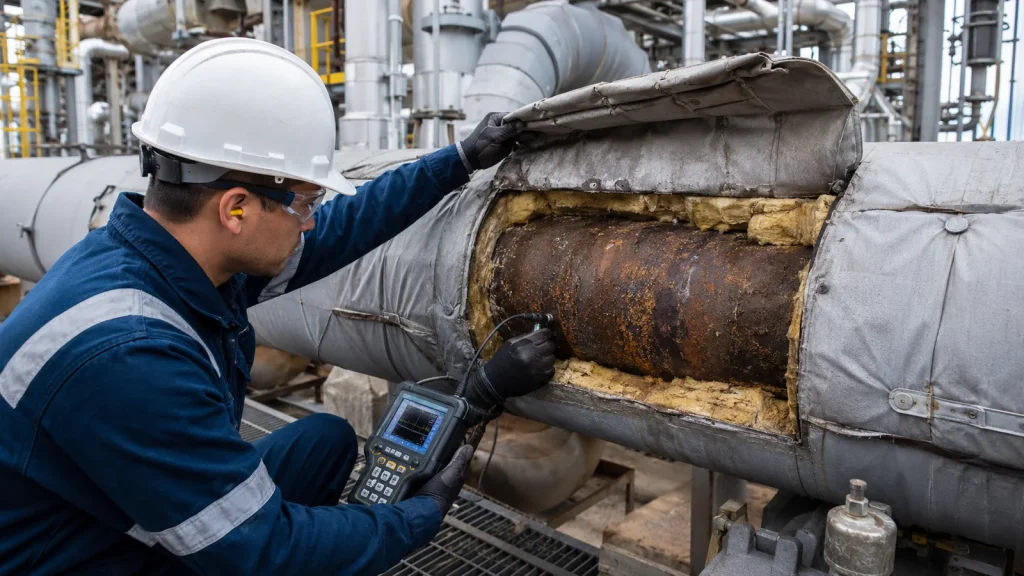
Identifying and Controlling Corrosion Hidden Beneath Insulation
Corrosion under insulation (CUI) is a hidden external-corrosion threat affecting insulated piping, vessels, tanks and equipment when water enters or remains trapped within the insulation system. Because deterioration develops beneath cladding and insulation, significant wall loss can progress without obvious surface indications.
Colossal Consultants helps operators identify susceptible equipment, prioritise inspection locations and develop practical CUI management programmes. Our assessment considers operating temperature, insulation and cladding condition, environmental exposure, material of construction, coating condition, water-ingress paths, inspection history and evidence of previous corrosion. The result is a focused plan for detecting damage, repairing deficiencies and reducing recurrence.
Our Corrosion Under Insulation Assessment Approach
The assessment begins by defining the insulated piping, vessels, tanks and equipment within the study scope. We review available line lists, equipment registers, piping and instrumentation diagrams, operating temperatures, materials of construction, insulation specifications, coating systems, inspection records, maintenance history and reported water-ingress locations.
Each item is screened for factors that increase CUI susceptibility, including cyclic or intermittent operation, damaged cladding, penetrations and termination points, poor weather sealing, low points, supports, nozzles, steam tracing, coastal exposure and areas subjected to washdown or rainfall. The assessment then identifies priority locations where insulation removal, visual examination or suitable nondestructive inspection should be considered.
Findings are evaluated to determine the extent of deterioration and the appropriate response. Recommendations may include local or wider insulation removal, thickness measurement, coating repair, replacement of wet insulation, cladding and sealing improvements, drainage corrections, inspection intervals and follow-up monitoring. This focused CUI assessment supports—but does not replace—broader corrosion management, Risk-Based Inspection, coating evaluation or laboratory corrosion testing.
CUI Assessment, Inspection Priorities and Practical Deliverables
The completed assessment converts asset information, operating conditions and CUI susceptibility factors into a practical inspection and remediation plan. It identifies where hidden corrosion is most likely, which locations should receive priority attention and what corrective or preventive measures should be considered.
Typical deliverables may include:
- Defined CUI assessment scope and insulated-asset register
- Review of operating temperatures, materials, insulation, coatings and cladding systems
- CUI susceptibility screening and priority ranking
- Identification of vulnerable locations, water-ingress paths and damaged weather barriers
- CUI inspection zones or circuits for piping and equipment
- Marked-up line lists, equipment registers or drawings showing priority locations
- Recommended locations for insulation removal and direct visual examination
- Recommendations for ultrasonic thickness measurement or suitable screening NDT
- Assessment of observed corrosion extent and remaining-wall concerns
- Coating repair, insulation replacement and cladding restoration recommendations
- Improvements to sealing, terminations, penetrations, drainage and weather protection
- Inspection intervals, follow-up monitoring and reassessment requirements
- Coordination recommendations for separately scoped RBI, corrosion management, coating evaluation or specialist testing
Material & Corrosion
- Failure Analysis and Root Cause Investigation
- Material Selection and Corrosion Engineering
- Corrosion Risk Assessment Study – CRAS
- Corrosion Management and Monitoring
- Corrosion Under Insulation Assessment and Management
- Microbiologically Influenced Corrosion Assessment and Control
- Coating Assessment and Evaluation
- Cathodic Protection
- Corrosivity and Corrosion Testing
Corrosion Under Insulation Assessment and Management FAQs
Corrosion under insulation is external corrosion that develops beneath insulation and protective cladding when moisture reaches the equipment surface. It is difficult to detect because the affected metal is concealed, and substantial wall loss may occur before staining, damaged cladding or other external signs become visible.
CUI may affect insulated carbon-steel and stainless-steel piping, vessels, tanks and equipment. Vulnerable areas commonly include damaged cladding, insulation terminations, penetrations, supports, low points, nozzles, steam-traced lines, cyclic-service equipment and locations exposed to rainfall, washdown, coastal conditions or persistent humidity.
Yes. Asset records, operating conditions, visual condition of the insulation system and suitable screening inspection methods can be used to identify priority areas. Targeted insulation removal and direct examination are then recommended at selected locations rather than removing insulation from every item indiscriminately.
A CUI assessment focuses specifically on hidden external corrosion beneath insulation and on the locations most likely to experience water ingress and deterioration. RBI prioritises broader equipment risks, corrosion management coordinates multiple corrosion threats and controls, while coating evaluation examines coating condition and performance. These services may support one another but are not interchangeable.
A CUI assessment typically provides a susceptible-asset register, priority ranking, identified inspection zones, recommended locations for insulation removal or screening NDT, findings on observed deterioration, and practical recommendations for coating repair, insulation replacement, cladding restoration, weather sealing, drainage, inspection intervals and follow-up monitoring.